



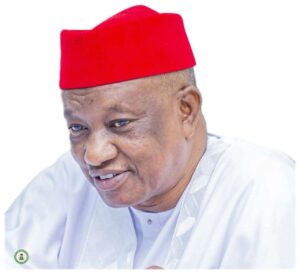

The Kano triumvirate: How the Kwankwaso-Abdulsalam-Gawuna matrix shapes the road to governorship
By Muhammad A. Bello, fsi.
The political landscape of Kano State has experienced a dramatic seismic shift. The emergence of Comrade Aminu AbdulSalam as the governorship candidate of the Nigeria Democratic Congress (NDC) has rewritten the rules of engagement ahead of the next executive race. Far from a standard party nomination, AbdulSalam’s ticket represents a masterclass in strategic realignment, driven by the enduring influence of Senator Rabiu Musa Kwankwaso and a highly calculated tactical pivot by former Deputy Governor Nasir Yusuf Gawuna.
To understand why AbdulSalam is suddenly holding a winning hand, one must look at how the chess pieces have moved across the state, transforming potential rivalries into a unified, mathematically devastating electoral frontline.
The first major catalyst in this new political dispensation is Nasir Yusuf Gawuna’s decision to accept the NDC’s Senatorial nomination. For a man who came within a hair’s breadth of the governorship in the previous cycle, stepping back from the ultimate executive prize to clear the path for AbdulSalam is a monumental concession.
However, far from a retreat, Gawuna’s move is a profound act of realpolitik. By securing the Senatorial ticket under the burgeoning banner of the NDC, Gawuna accomplishes three things simultaneously:
One, consolidation of power. He avoids a bruising, resource-draining primary battle that could have fractured the opposition.
Two, preservation of local influence. He solidifies his stronghold over his core urban constituencies, positioning himself as a legislative heavyweight.
Three, unified frontline. He creates an ideological bridge, turning what would have been a chaotic multi-polar fight into a disciplined, multi-layered alliance focused on taking the state house.
Kano voters are notoriously sophisticated; they vote for structures, they vote for ideologues, and they vote for proven competence. The potency of AbdulSalam’s candidacy lies in how his platform perfectly synthesizes three distinct layers of political capital: the institutional gravity of Rabiu Musa Kwankwaso, the rural-urban synergy,
the stability dividend; and, the sentiment of justice.
Senator Rabiu Musa Kwankwaso remains the undisputed architect of contemporary Kano grassroots politics. His inclusion in the NDC framework has instantly transferred a massive, intensely loyal voting bloc to the party. The red-cap movement treats Kwankwaso’s endorsement not just as a political preference, but as a socio-economic directive. His structural machinery guarantees an organic, high-turnout base across all 44 Local Government Areas—an operational floor that no rival party can easily dismantle.
Kwankwaso’s iron grip on the rural local governments combines flawlessly with Gawuna’s profound popularity in the metropolitan areas. This leaves the ruling incumbency with virtually no geographical sanctuary to exploit. Kano people are historically wary of prolonged political warfare that disrupts commerce and governance. The fact that heavyweights like Kwankwaso and Gawuna are pulling the strings in the same direction provides voters with a sense of structural predictability and peace. AbdulSalam’s personal history of resilience and administrative loyalty resonates deeply with a population that prides itself on rewarding steadfastness and correcting political anomalies.
To fully appreciate the gravity of Kwankwaso’s grassroots infrastructure and how it collides with Gawuna’s structural popularity, one must audit the historical baseline of the 2023 gubernatorial election. The 2023 race was a direct, high-stakes collision between the sitting incumbency represented by Nasir Yusuf Gawuna (APC) and Engr. Abba Kabir Yusuf—who ran as Kwankwaso’s chosen proxy and candidate under the New Nigeria Peoples Party (NNPP) before a subsequent defection cycle altered the alignment.
The certified final metrics released by the Independent National Electoral Commission (INEC) reveal how razor-thin the margins of control are in this complex state, demonstrating that when Kwankwaso’s rural machinery battles Gawuna’s urban base, Kano splits directly down the center
To fully appreciate the gravity of Kano’s contemporary political landscape and how its competing structures collide, one must audit the historical baseline of the 2023 gubernatorial election. The 2023 race was a direct, high-stakes confrontation between the sitting incumbency, represented by Dr. Nasir Yusuf Gawuna of the All Progressives Congress (APC), and Engr. Abba Kabir Yusuf, who ran as the chosen proxy and candidate of Senator Rabiu Musa Kwankwaso under the banner of the New Nigeria Peoples Party (NNPP). The final certified metrics released by the Independent National Electoral Commission (INEC) reveal not only the immense scale of the state’s voting population but also how razor-thin the margins of absolute control remain in this highly sophisticated political theater.
Out of a massive pool of 5,921,370 registered voters, the electorate split almost directly down the center, reflecting a deeply entrenched polarization between populist grassroots movements and established administrative networks. Engr. Abba Kabir Yusuf secured the victory by commanding a total of 1,019,602 votes, which translated to 51.55% of the overall valid ballots cast. This milestone crossing of the one-million-vote threshold firmly validated the potent, organic infrastructure of Kwankwaso’s red-cap movement, particularly across the state’s sprawling rural and semi-urban local government areas.
Conversely, Dr. Nasir Yusuf Gawuna maintained an exceptionally resilient baseline, capturing 890,705 votes and securing a formidable 45.03% of the total vote share. Running under the weight of a two-term incumbent administration’s structural fatigue, Gawuna’s ability to rally nearly 891,000 voters underscored his immense personal popularity, especially within the critical metropolitan and commercial centers of Kano municipal. The minor parties were completely marginalized in this fierce duopoly, as evidenced by the People’s Democratic Party (PDP) candidate, Sadiq Wali, who trailed distantly with a mere 15,957 votes, representing just 0.81% of the total turnout.
Ultimately, the entire executive destiny of Kano State was decided by a margin of victory of just 128,897 votes, or a tight 6.52%. This narrow statistical spread proves that neither faction holds an absolute monopoly over the state. It demonstrates that when Kwankwaso’s formidable grassroots engine and Gawuna’s fiercely loyal urban base go to war, the state is pushed to its mathematical limits. It is precisely this historical equilibrium that makes any future consolidation or alliance between these structural power blocs an analytically devastating force on the Kano political chessboard.
This statistical framework shows that despite running against a massive, populist wave driven by Kwankwaso, Gawuna maintained an incredibly resilient baseline of nearly 891,000 votes. He heavily dominated the urban municipal centers and held a formidable 45% of the entire state’s voting population. By bringing the exact structure that yielded over a million votes for Kwankwaso’s platform and the engine that powered Gawuna’s 890,000-strong urban base under the same NDC umbrella, the historical opposition blocks have effectively fused into an unstoppable arithmetic entity.
Gawuna brings an entirely different flavor of popularity to the table. Revered for his calm demeanor, administrative maturity, and extensive experience across multiple administrations, Gawuna appeals directly to the civil service, the business elite, and the moderate voters of Kano municipal. By active association and his own legislative run, Gawuna’s massive popularity ensures that urban centers and establishment voters who might have been skeptical of pure grassroots populism are now firmly inside the NDC tent.
Comrade Aminu AbdulSalam is not merely a beneficiary of powerful backers; he is a formidable political force in his own right. As an experienced former local government chairman, commissioner, and deputy governor, his Comrade moniker is backed by decades of actual advocacy for the talakawa (the commoners). He possesses a distinct grassroots charm, a reputation for unyielding loyalty, and a deep understanding of state affairs. AbdulSalam represents continuity without complacency—a bridge between the seasoned governance of the old guard and the urgent developmental aspirations of the youth.
When Kano voters step into the booths, they will not see Aminu AbdulSalam standing in isolation. They will see an unprecedented alliance designed to govern effectively from day one. This structural combination targets every vital demographic in Kano’s voting ecology.
The emergence of Comrade Aminu AbdulSalam as the NDC governorship candidate is a masterstroke that alters the destiny of Kano State. By pairing his own rich, activist-technocratic pedigree with the unmatched grassroots reach of Kwankwaso and the refined, urban popularity of Gawuna, the NDC has built a near-impenetrable political fortress.
Gawuna’s transition to the Senatorial track did not diminish his stature; it supercharged the entire opposition ticket. For the people of Kano, a vote for AbdulSalam is no longer an electoral gamble—it is a calculated vote for a unified, powerhouse coalition capable of returning governance to the people.
Bello resides in Abuja.